
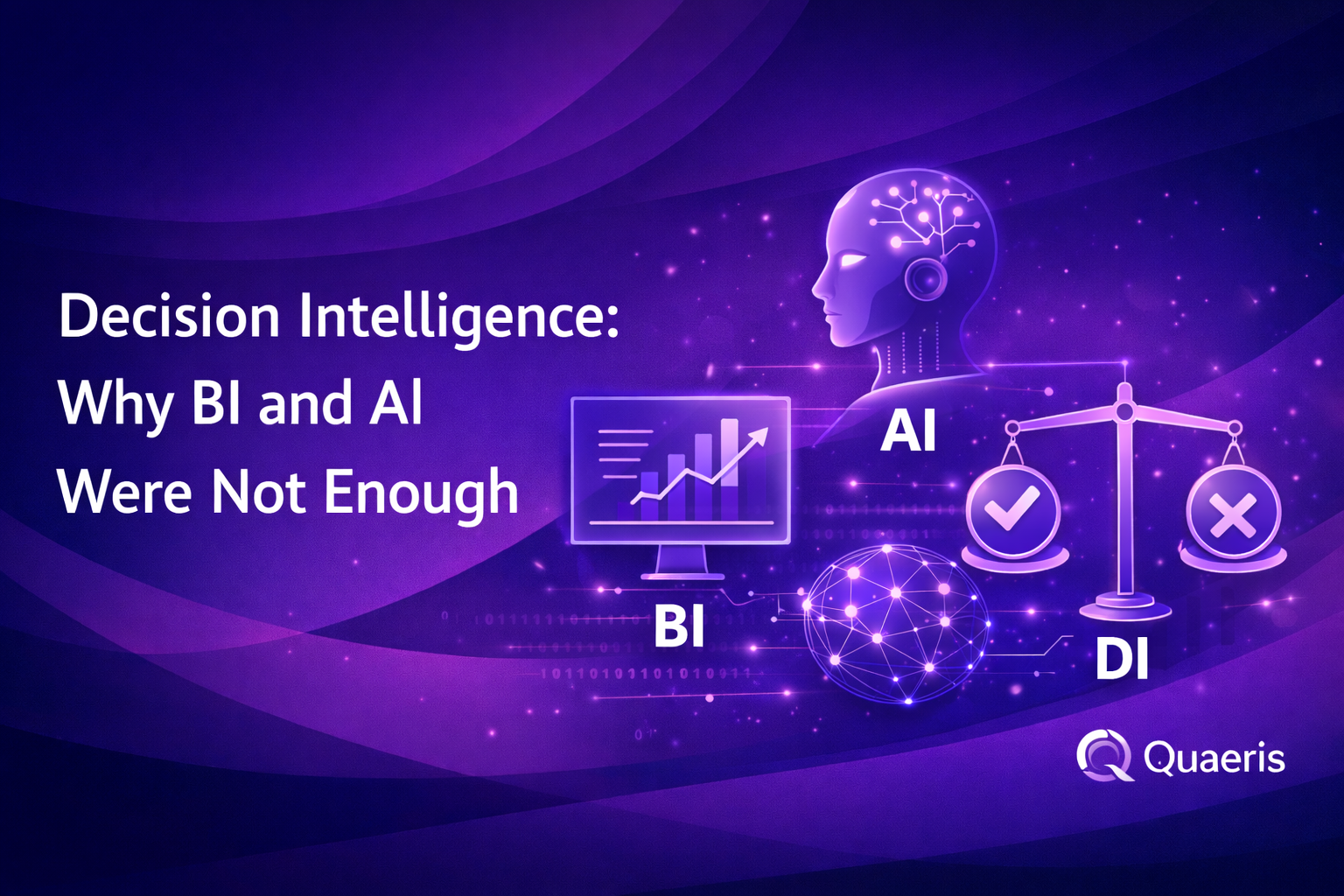
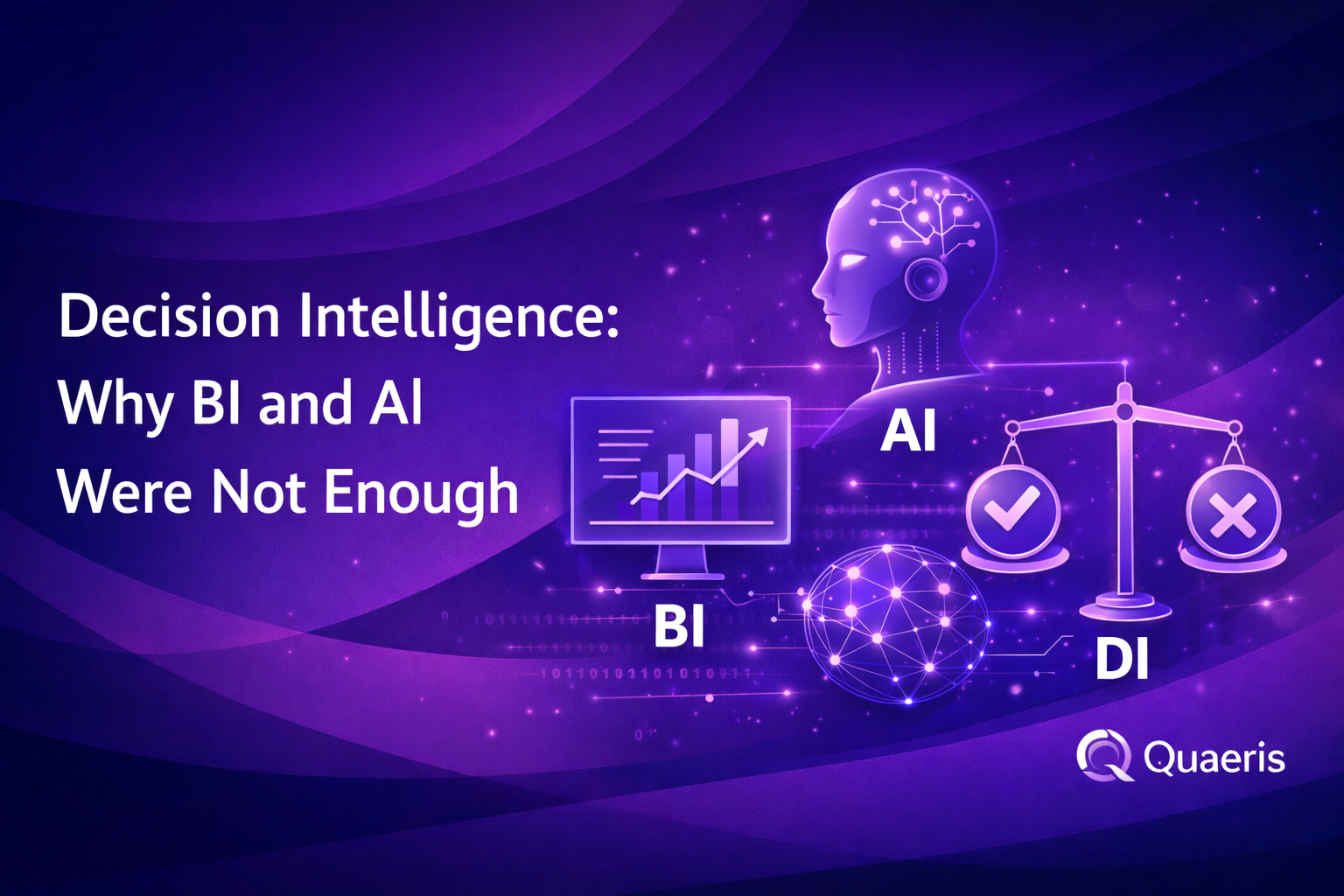
Decision Intelligence: Why BI and AI Were Not Enough
Business intelligence changed how organizations saw data.
Artificial intelligence changed how systems processed data.
Yet many decisions are still slow, debated, or avoided.
This gap is why decision intelligence matters.
Decision intelligence is not a buzzword. It is the next stage in how organizations turn information into action. It builds on BI and AI but solves a different problem.
Not insight.
Not prediction.
But confidence at the moment of decision.
The Limits of Business Intelligence
Business intelligence did important work.
It helped teams:
- Centralize reporting
- Track performance
- Standardize metrics
- Answer known questions
Dashboards became the system of record. They showed what happened and how things changed over time.
But BI had limits.
It struggled with:
- One off questions
- Cross system context
- Fast moving situations
- Ambiguous business language
Most importantly, BI assumed decisions would follow insight automatically.
In practice, they did not.
Teams debated dashboards. Meetings restarted the same conversations. Analysts rebuilt views. Leaders waited for certainty that never arrived.
BI delivered visibility. It did not deliver movement.
The Rise of AI and Its New Problems
AI promised to fix what BI could not.
Machine learning models predicted outcomes. Natural language interfaces made data easier to ask questions of. Automation reduced manual work.
This helped. But it introduced new challenges.
AI systems often:
- Produced answers without explanation
- Worked outside governance
- Lacked shared definitions
- Created speed without trust
In many organizations, AI tools were bolted onto existing workflows. They sat beside decisions instead of shaping them.
Leaders saw potential. They did not always see impact.
This is where the story changed.
What Decision Intelligence Actually Is
Decision intelligence focuses on the decision itself.
It asks a different set of questions:
- Who needs to decide
- What context they need
- What tradeoffs exist
- What happens next
Decision intelligence connects data, models, rules, and human judgment into a single flow.
It is not a tool.
It is a system.
At its core, decision intelligence:
- Combines BI visibility with AI reasoning
- Embeds insight into real workflows
- Makes trust and explainability explicit
- Reduces the time between question and action
This is why it resonates today.
How Decision Intelligence Builds on BI
Decision intelligence does not replace BI. It depends on it.
BI provides:
- Historical context
- Metric stability
- Shared measurement
- Data discipline
Decision intelligence uses this foundation but moves beyond static views.
Instead of asking users to navigate dashboards, it:
- Translates business language into data logic
- Pulls context from many systems
- Surfaces relevant insight at the right moment
- Supports follow up questions naturally
BI answers what happened.
Decision intelligence helps decide what to do.
How Decision Intelligence Uses AI Differently
AI inside decision intelligence has a clear job.
It is not there to impress. It is there to reduce hesitation.
AI supports decision intelligence by:
- Detecting change early
- Recommending next steps
- Learning from prior decisions
- Explaining reasoning clearly
Crucially, AI operates inside guardrails.
Definitions are governed. Sources are visible. Confidence levels are clear. Humans remain accountable.
This balance is why decision intelligence scales where standalone AI tools often stall.
Why Decision Intelligence Matters Now
Modern organizations face a new reality.
They have:
- More data than ever
- Faster cycles
- Higher risk
- Less tolerance for delay
At the same time, decision making has become more complex. Decisions cross teams, systems, and timelines.
The cost of waiting is no longer abstract. It shows up as:
- Missed windows
- Budget waste
- Operational risk
- Strategic drift
Decision intelligence addresses this moment.
It is designed for environments where speed matters but mistakes are expensive.
From Self Service to Shared Confidence
For years, the industry talked about self service analytics.
The goal was access. Let more people use data.
But access alone did not solve the problem. In many cases, it created more confusion.
Decision intelligence shifts the goal.
The goal is shared confidence.
Instead of everyone building their own view, teams:
- Ask questions in plain language
- Rely on shared definitions
- See the same answers
- Move together
This reduces conflict and increases alignment.
What Changes Inside Data Teams
Decision intelligence reshapes the role of data teams.
Analysts are no longer just report builders. They become:
- Semantic owners
- Context designers
- Trust stewards
- Decision partners
Their work shifts upstream. They define how questions map to data. They guide how AI behaves. They ensure answers are safe to use.
This increases their impact and visibility.
Decision intelligence does not replace data teams. It elevates them.
What Changes for Business Leaders
For leaders, decision intelligence changes how conversations happen.
Meetings focus less on arguing over numbers and more on choosing direction.
Questions become:
- What changed
- Why it matters
- What we do next
Leaders gain clarity without waiting. They act with context, not instinct alone.
This is where value appears.
A Grounded Takeaway
Business intelligence helped organizations see.
Artificial intelligence helped systems think.
Decision intelligence helps people decide.
It connects insight to action in a way older approaches could not. It respects governance while increasing speed. It blends human judgment with machine support.
At Quaeris, we believe the future of analytics is not about more dashboards or smarter models. It is about closing the gap between knowing and doing.
Decision intelligence exists for one reason.
So decisions arrive on time.