
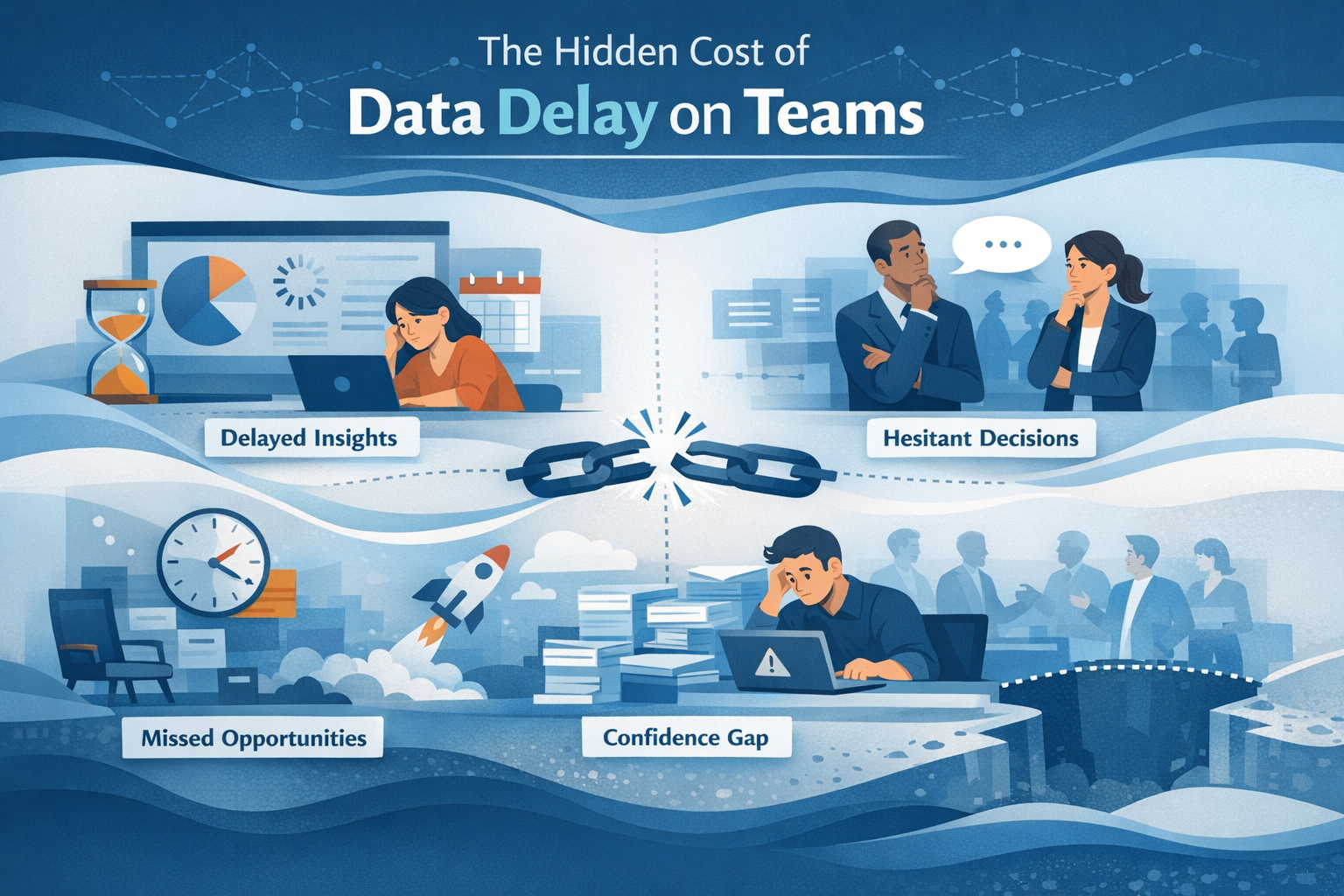
Data leaders rarely struggle with access to data.
Most organizations already have warehouses, dashboards, BI tools, and reports.
The real problem shows up later.
It shows up when a question is asked, and the answer arrives too late to matter.
This delay does not always look dramatic. There is no outage. No failed system. No red alert. Instead, it appears quietly, inside teams, meetings, and decisions.
And over time, it becomes expensive.
When answers lag, behavior changes
Inside modern organizations, data delay reshapes how people work.
At first, teams wait.
They trust the process.
They assume the answer is coming.
Then they adapt.
They make assumptions.
They reuse old numbers.
They rely on instinct.
They ask fewer questions.
None of this happens because people do not care about data. It happens because waiting has a cost, and teams feel it every day.
When answers do not arrive at the speed of the business, people stop planning around data and start working around it.
That is the hidden shift.
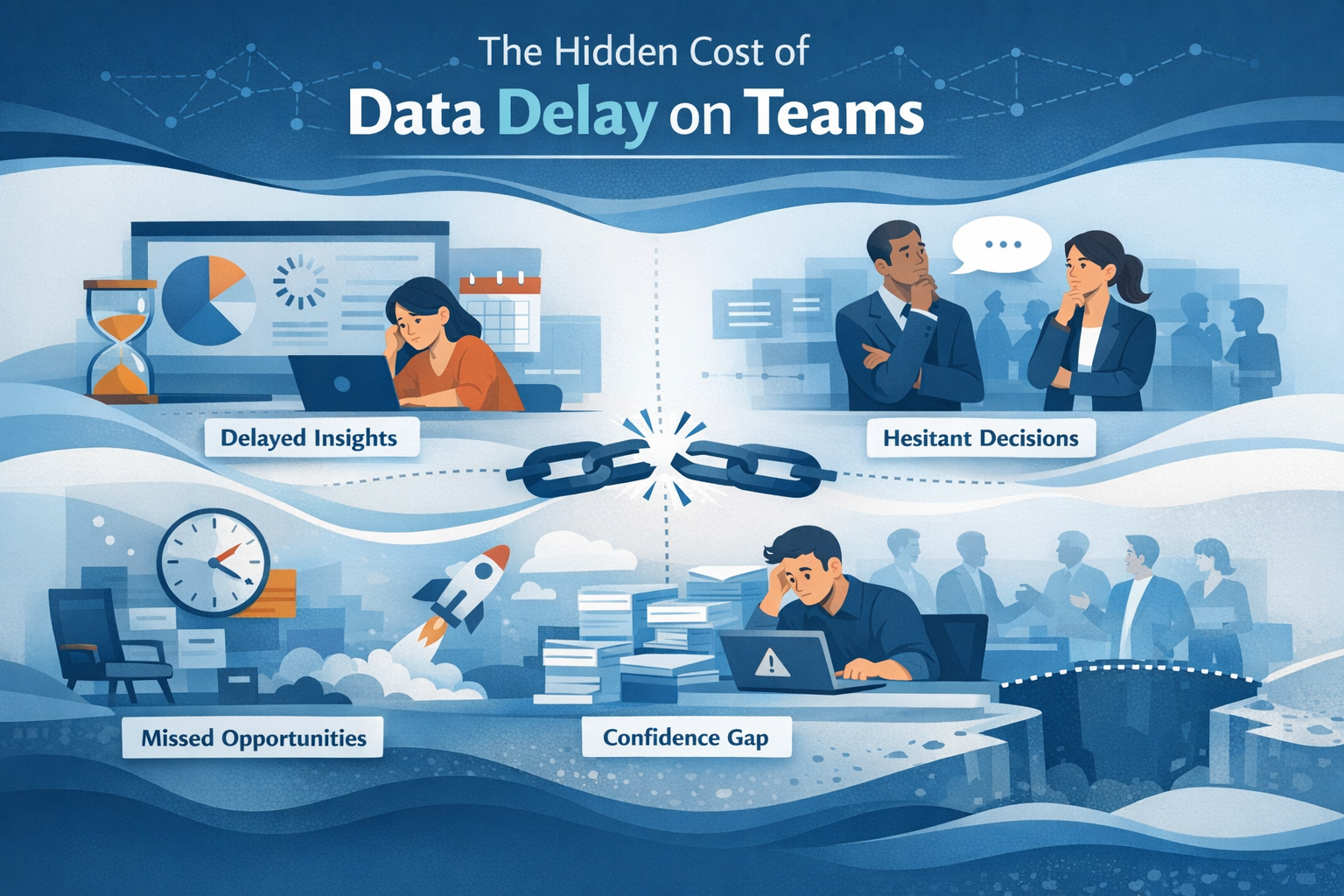
The visible costs are only the surface
Data leaders are used to tracking visible costs.
Dashboard backlogs.
Rising BI spend.
Analyst burnout.
Tool sprawl.
These are real problems, but they are not the most damaging ones.
The deeper cost shows up in missed moments.
A pricing decision delayed by a week.
A campaign adjusted after the window closes.
A risk flagged after exposure grows.
A meeting that restarts the same debate.
Each delay seems small on its own. Together, they compound.
Over time, organizations lose speed not because they lack data, but because they lack confidence in acting on it.
Delay breaks alignment before it breaks systems
Most data delays are not caused by technology alone.
They are caused by handoffs.
Between leaders and analysts.
Between dashboards and documents.
Between numbers and context.
A dashboard might show what happened.
The explanation lives in a slide deck.
The assumptions are buried in email threads.
The risk notes sit in a document folder.
When context is fragmented, alignment slows down.
People spend more time validating than deciding.
More time explaining than acting.
More time defending numbers than using them.
This is where momentum fades.
Analysts become buffers instead of force multipliers
Data teams feel this pressure first.
As demand grows, analysts become translators, validators, and traffic controllers. Every new question adds work. Every follow up creates another loop.
The role quietly shifts.
From problem solving
to ticket management.
From strategic partner
to response engine.
This is not a skill issue. It is a flow issue.
When teams depend on humans to bridge every gap between question and answer, delay becomes inevitable. And when analysts are underwater, trust erodes on both sides.
Business teams feel blocked.
Analysts feel blamed.
No one feels fast enough.
Leaders feel the delay as risk
Executives experience data delay differently.
They feel it as hesitation.
When answers arrive late or incomplete, leaders hedge. They ask for more validation. They schedule another review. They postpone commitment.
This is not indecision. It is risk management.
But delay creates a paradox.
The longer leaders wait for certainty, the more risk accumulates. Markets move. Conditions change. Windows close.
Eventually, decisions get made anyway. Just without the clarity data was supposed to provide.
That is when instinct fills the gap.
The confidence gap grows quietly
Over time, organizations develop what can be called a confidence gap.
Data exists.
Questions exist.
Decisions stall anyway.
This gap is not obvious in dashboards or reports. It shows up in behavior.
Fewer exploratory questions.
More static reporting.
Less curiosity.
More politics.
Teams stop asking what could be done and focus on defending what already happened.
This is the real cost of data delay.
Not slower answers.
Slower thinking.
Speed without trust makes things worse
Many organizations try to fix delay by adding speed.
Faster dashboards.
More self service tools.
More alerts.
More automation.
Speed helps, but only when trust is present.
When teams move faster on answers they do not trust, risk increases. Errors propagate. Decisions get challenged after the fact. Confidence drops further.
This is why some teams act more, but decide less.
Action without confidence creates noise.
Confidence without speed creates inertia.
Both fail.
Decisions need context, not just data
Most decisions do not fail because the numbers are wrong.
They fail because context is missing.
Why did this change?
What assumptions were made?
What else was happening at the same time?
What risks were noted?
When context lives outside the answer, alignment slows. Every decision requires a meeting. Every meeting reopens the same questions.
Teams spend their energy reconstructing meaning instead of moving forward.
When context travels with answers, decisions accelerate naturally.
The moment teams stop asking is the warning sign
The most dangerous signal is silence.
When teams stop asking questions, it feels calm.
Backlogs shrink.
Meetings get shorter.
Reports look stable.
But this is not health. It is withdrawal.
People stop asking because asking takes too long.
Because answers arrive too late.
Because the effort no longer feels worth it.
By the time leaders notice, momentum is already lost.
Restoring flow changes everything
When answers arrive with clarity, context, and trust, behavior shifts.
Analysts move upstream.
Business teams act sooner.
Leaders commit faster.
Meetings change tone.
Questions get sharper.
Decisions stick.
The organization regains flow.
Not by adding more data.
Not by replacing every tool.
But by closing the gap between question and action.
What data leaders can do next
Data leaders sit at the center of this problem and the solution.
The goal is not perfection.
It is momentum.
Reduce the time between question and trusted answer.
Keep context close to insight.
Protect analysts from becoming bottlenecks.
Design for decisions, not reports.
When teams trust answers, they move.
When they move, value follows.
The hidden cost of data delay is not technical debt.
It is hesitation.
And hesitation is the one thing modern organizations cannot afford.