
From PBC collection to workpaper documentation, discover how QuaerisAI's Agentic Layer, Semantic Layer, and Converged Search reclaim up to 100 hours per audit engagement — and what that means for your firm's margins, talent, and quality.
How QuaerisAI is Shifting the Profession from "Manual & Sample-Based" to "Agentic &
Continuous"
Here is the uncomfortable reality facing accounting firms in 2026: the accounting workforce has
shrunk by over 17% since 2020, regulatory scrutiny is intensifying, and clients expect more —
faster — for the same fee. The traditional audit model, built on sampling, manual document
matching, and hours of workpaper writing, was never designed to absorb this pressure.
Something has to change. Not incrementally — structurally.
QuaerisAI is built for exactly this shift. Not as another analytics dashboard that auditors need to
learn. Not as a generic AI assistant that guesses at financial figures. But as a purpose-built
Agentic Audit Intelligence platform that fundamentally changes the economics, quality, and
scalability of the modern audit engagement.
Here is what that transformation looks like — phase by phase, number by number.
The Architecture Behind the Advantage
Before diving into specific use cases, it's worth understanding what makes QuaerisAI different
from standard AI tools being applied to audit workflows. Three components work together:
The Agentic Layer — Instead of waiting for an auditor to ask a question, QuaerisAI's agents act
autonomously. They go find data, flag anomalies, test populations, and draft documentation
without a human having to trigger each step.
The Semantic & Context Layer — A single, vetted source of truth for all audit logic and business
definitions. When QuaerisAI says "Gross Contribution Margin," it's using the exact calculation the firm defined — not an LLM approximation. This eliminates the hallucination risk that makes generic
AI tools unusable in a regulatory context. The Semantic Layer captures your business lingo that is used across your/your client's organization with standardized ontology.
Converged Search — A unified interface that links structured data (ERP systems, ledger entries,
databases) with unstructured evidence (PDF contracts, invoices, bank statements). Auditors can
query both simultaneously, in plain English.
Together, these three capabilities transform each phase of an audit engagement. Let's walk
through them.
Phase 1: Data Intake & PBC Collection — Stop Chasing, Start Reviewing
The traditional pain: Every audit begins with a "Prepared By Client" (PBC) list — a manual
request for documents that kicks off weeks of follow-up emails, missing files, version conflicts,
and administrative back-and-forth. For most firms, this phase alone consumes 20% of total
engagement hours.
The QuaerisAI approach: Automated PBC Agents connect directly to the client's data lakes and
systems, retrieving and verifying evidence autonomously — without waiting for the client to
send it.
The auditor stops being a document chaser. They become a document reviewer.
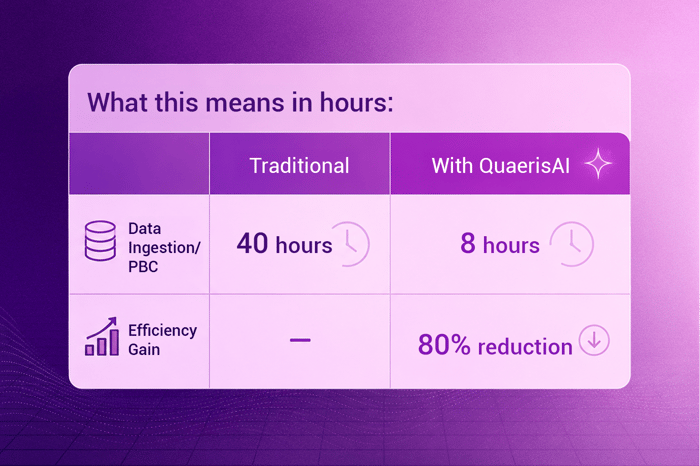
This isn't marginal. An 80% reduction in administrative follow-up time — on a phase that
typically consumes 40 hours per engagement — frees senior staff for the judgment-intensive
work that actually requires their expertise.
Phase 2: Transaction Testing — From Sampling to 100% Population Coverage
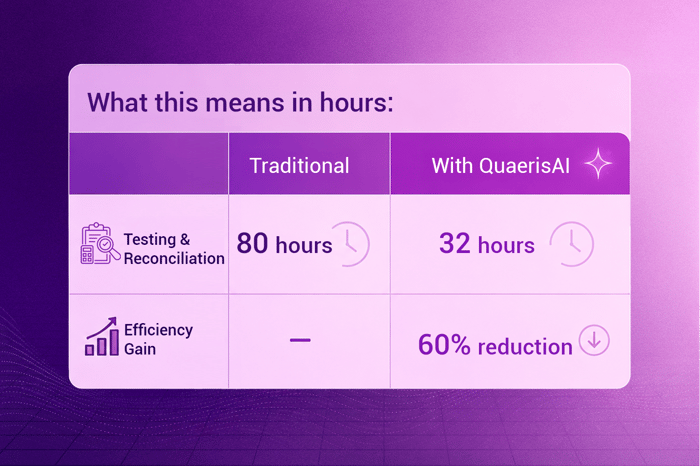
The traditional pain: The cornerstone of traditional audit testing is statistical sampling. Test 50 to 100 transactions. Assume the rest are fine. Hope nothing significant hides outside the sample. This approach was a practical necessity — not a methodology preference. It was the only option when testing every transaction required human eyes on every document.
The QuaerisAI approach: Autonomous agents scan every single transaction in the population for anomalies. Not a sample. Every transaction. Agents use Self-Generating SQL to accelerate the investigation of outliers — without requiring an IT expert or SQL-fluent auditor to write a single query. This isn't just a speed improvement. It's a coverage transformation. Audit risk doesn't hide in the sample — it hides in what the sample misses.
Phase 3: Evidence Vouching — Linking the Ledger to the Document
The traditional pain: One of the most labor-intensive tasks in any audit is vouching — manually matching ledger entries to their underlying evidence: PDF invoices, contracts, purchase orders, bank statements. A senior associate sitting at a desk, cross-referencing document against document, for hours.
Humans get fatigued at hour 10 of vouching. Agents do not.
The QuaerisAI approach: Converged Search agents automatically link structured ERP data to unstructured document evidence. Using NLP and OCR integration, QuaerisAI can "read" contracts to confirm whether revenue recognition matches the terms actually written in the fine print. The system flags the 5% that don't reconcile. The auditor reviews those — not the 95% that are correct.
"Show me all intercompany transfers that lack a signed agreement."
That plain-English question, asked directly to QuaerisAI, replaces hours of manual cross referencing. No SQL. No dashboard navigation. No training required.
Phase 4: Control Monitoring — From Annual Checks to Continuous Assurance
The traditional pain: Internal controls are typically assessed at a point in time — once a year, or once a quarter. In a business environment that changes weekly, this creates a structural blind spot. Policy drift, new transaction patterns, emerging anomalies — these can live undiscovered for months between assessments.
The QuaerisAI approach: Real-time Continuous Assurance monitoring flags policy drift the moment it happens. Rather than discovering a control failure during the annual assessment, firms and their clients know about it in real time.
The Semantic Layer is the key enabler here. Because all audit logic is defined in one vetted source of truth, monitoring rules are applied with 100% consistency — not interpreted differently by different staff members across different engagements.
This capability moves audit from a retrospective compliance exercise to a forward-looking risk management function — a shift that many audit firm clients are actively seeking.
Phase 5: Workpaper Documentation — From Writing to Reviewing
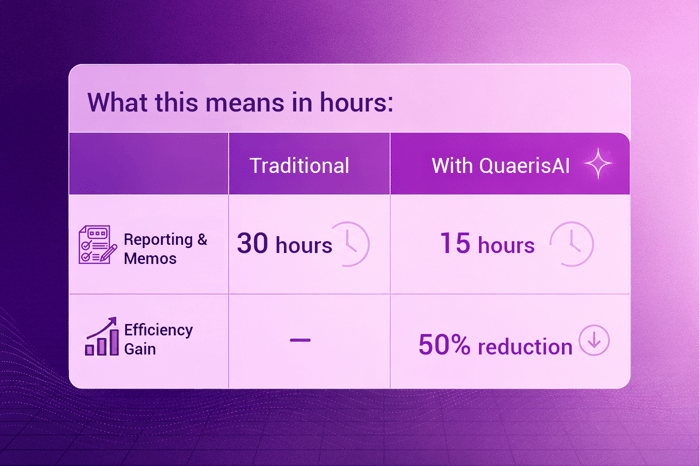
The traditional pain: Auditors spend approximately 40% of their time on documentation — drafting workpapers, writing memos to explain testing methodology, citing evidence, summarizing conclusions. This is not trivial work, but it is also not the work that requires a credentialed auditor's highest-order judgment.
The QuaerisAI approach: Narrative Agents automatically draft the "Memo to File" — explaining testing logic, documenting the reasoning path, and citing the evidence used. The auditor's role shifts from writing the first draft from scratch to reviewing and signing off on a draft that has already been generated.
This is Zero-Dashboard BI applied to documentation. No new tool to learn. No template to fill out. Auditors ask for the summary in plain English and receive a professional first draft.
Phase 6: Risk Assessment — From Gut Feel to Predictive Intelligence
The traditional pain: Audit risk assessment has historically been driven by two things: the prior year's workpapers and the senior partner's intuition. Both are useful. Neither is sufficient in a business environment defined by rapid change, new transaction structures, and sophisticated financial engineering.
The QuaerisAI approach: Predictive Risk Mapping analyzes current-year trends to suggest high-risk focal points before the audit begins. The Agentic Reasoning capability connects disparate data points to surface non-obvious fraud patterns — the kind that don't appear in a single anomalous transaction but emerge only when multiple signals are correlated across systems.
This is where AI delivers differentiated value beyond efficiency. Not just doing the existing workflow faster — but identifying risks that the existing workflow would never have caught.
The Full Picture: What 59% Time Reduction Means for Your Firm
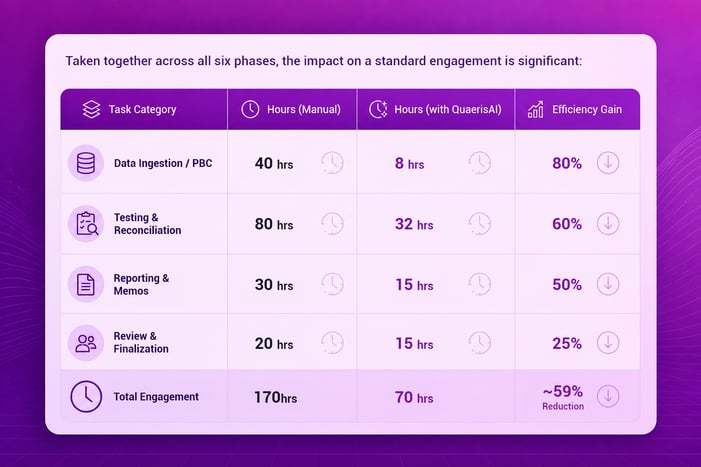
For a typical mid-sized engagement that runs 200 hours, QuaerisAI realistically reclaims 80 to 100 hours. That's not an incremental efficiency improvement. That's a fundamentally different engagement economics model
Why This Is Different From "Standard" AI Tools
The accounting profession has seen a wave of AI tools marketed at audit teams. Most of them share the same fundamental weakness: they are general-purpose language models applied to a specialized domain without the guardrails that domain requires.
QuaerisAI addresses this directly in three ways:
Trust via the Semantic Layer. Unlike standard LLMs that can "hallucinate" a financial figure — generating a plausible-sounding answer that is factually wrong — QuaerisAI's Semantic Knowledge Graph ensures the system only uses vetted, audited business logic. Every metric, every calculation, every definition has been defined and approved by the firm. The system cannot improvise.
Zero-Dashboard Efficiency. Adopting a new analytics platform in an audit environment typically requires weeks of staff training and change management. QuaerisAI eliminates this friction entirely. Auditors don't learn new software — they ask questions in plain English and receive answers. Training time approaches zero.
Solves the Talent Crisis Directly. With the accounting workforce down over 17% since 2020, firms are being asked to do more with fewer people. QuaerisAI acts as a Digital Associate — handling the grunt work of vouching, reconciliation, and documentation so that senior auditors can focus on the high-level judgment that actually requires their expertise and credential.
The ROI for Audit Partners: Four Numbers That Matter
For firm partners evaluating this investment, the financial case comes down to four dynamics:
1. Increased Leverage A single Senior Associate, supported by QuaerisAI Agents, can now effectively oversee 3–4 engagements simultaneously rather than 1–2. This multiplies revenue capacity without proportionally increasing headcount costs.
2. Margin Protection In a fixed-fee audit environment — which is the dominant pricing model for most mid-market engagements — every hour saved drops directly to the firm's bottom line. A 59% reduction in engagement hours on a fixed fee is not an efficiency metric. It is a margin metric.
3. Burnout and Retention Junior staff attrition is one of the most expensive operational problems accounting firms face today. The leading driver is well-documented: the disproportionate burden of low-value work — data entry, manual vouching, document chasing — in the early years of a career. By removing this work from the workflow, firms can meaningfully improve the experience for junior staff and reduce the attrition that is driving the talent shortage.
4. Error Reduction and PCAOB Risk Manual vouching at scale is vulnerable to human fatigue. Auditors get tired at hour 10 of matching invoices to ledger entries. Agents do not. This reduces both the risk of audit failure and the risk of a PCAOB (Public Company Accounting Oversight Board) deficiency finding — reputational and regulatory risks that no firm can afford.
The Shift That Is Already Happening
The audit profession is not waiting for AI to mature. The firms pulling ahead are deploying it now — using the talent shortage and regulatory pressure not as reasons to delay, but as the business case to accelerate.
The transition from "Manual & Sample-Based" to "Agentic & Continuous" auditing is not a five-year horizon. It is happening in 2026. The question is whether your firm is building the capability advantage now — or watching competitors do it first
See QuaerisAI in Action on Your Audit Workflows
QuaerisAI integrates with the data systems your clients already use — connecting to ERP platforms, data lakes, document repositories, and financial systems without moving or duplicating source data. Deployment is measured in days, not quarters. And because there's no dashboard to learn, adoption starts immediately.
What you can do from day one:
-
Automate PBC collection and evidence retrieval directly from client systems
-
Run 100% population testing instead of statistical samples
-
Vouch structured ERP data against unstructured PDF evidence simultaneously
-
Monitor controls in real time and receive alerts the moment policy drift occurs
-
Generate first-draft workpapers and memos automatically from completed testing
-
Conduct predictive risk mapping before the engagement begins
Ready to reclaim 80–100 hours per engagement?
Start Your Free Trial →
Or book a personalized demo to see QuaerisAI working through a real audit workflow — in under 30 minutes.
QuaerisAI is an Agentic AI platform purpose-built for data-intensive industries. Its Agentic Layer, Semantic Layer, and Converged Search architecture is trusted by audit, finance, insurance, banking, and SaaS teams to activate intelligence across structured data and unstructured documents — with enterprise-grade security and zero hallucination risk