

Why teams don't trust the data - and what to do about it
Why teams do not trust their data and how to fix it. Learn how to align definitions, eliminate conflicting numbers, and create one version of truth that drives faster decisions.

- NLQ is rapidly maturing and attracting heavy investment, moving beyond simple queries into visualization, anomaly detection, and recommendation systems.
- Healthcare, finance, and customer service teams are using NLQ to surface patterns in patient data, detect fraud, and automate customer responses at scale.
- NLQ is reshaping application design and the workplace by making software more accessible and giving non-technical users a natural way to query data.
- Education and policy making both benefit — from personalized learning feedback to analyzing socio-economic data for more informed decisions.
Why your team does not trust the data and what to do about it
Most teams do not have a data problem.
They have a trust problem.
Data exists. Reports exist. Dashboards exist.
Yet decisions still stall.
The issue is simple.
People do not trust the answer enough to act.
What distrust looks like inside your team
You see it every week.
- Two teams bring different numbers to the same meeting
- Leaders ask, “Which one is right?”
- Analysts go back to rework the same question
- The decision gets pushed
Nothing moves.
This is not a data failure.
This is a trust failure.
Why trust breaks
There are three root causes.
1. Conflicting numbers across teams
Marketing reports one number.
Finance reports another.
Operations has a third.
All are “correct.”
None are aligned.
Why this happens:
- Different data sources
- Different logic
- Different timing
Result:
No one knows what is true.
So teams debate instead of decide.
2. No shared definitions
Simple terms break fast.
Revenue
Customer
Active user
Churn
Each team defines them differently.
Even small differences create large gaps.
Example:
- One team counts booked revenue
- Another counts recognized revenue
Both sound right.
Both lead to different decisions.
Without shared definitions, every answer is unstable.
3. Answers without proof create hesitation
Many tools give answers.
Few explain them.
When someone asks,
“Where did this number come from?”
If the answer is unclear, trust drops.
And when trust drops, action stops.
This is the core issue:
If an answer cannot be explained, it cannot be used.
The real cost of low trust
Low trust does not stay in meetings.
It spreads across the business.
- Decisions slow down
- Teams repeat work
- Opportunities are missed
- Risk increases
Over time, something worse happens.
People stop relying on data.
They go back to instinct.
What middle managers need to fix
You do not need more dashboards.
You need one version of truth.
That comes from three shifts.
1. Align on shared definitions
Start here.
Pick your most important metrics.
Define them once.
Make them visible.
Everyone uses the same logic.
No exceptions.
This removes 50 percent of confusion.
2. Connect data across systems
Data lives in many places:
- BI tools
- CRM
- Finance systems
- Documents
If answers come from only one system, they are incomplete.
You need a layer that brings context together.
Structured and unstructured.
This is how answers become consistent.
3. Make every answer explainable
This is the unlock.
Every answer should show:
- Source
- Logic
- Context
If someone asks “why,” you can show it.
Not explain it from memory.
Show it in the system.
This is how trust is built.
The outcome: one version of truth
When these three shifts happen, something changes.
- Teams stop debating numbers
- Meetings move faster
- Decisions happen in the moment
Answers become shared, not questioned.
This is what Resonate means in practice.
The answer becomes something people believe and align around.
The one line to remember
Your team does not need more data.
Your team needs answers they trust enough to act on.
Fix trust, and speed follows.
Continue reading
View all posts →
How Decision Velocity Becomes a Competitive Advantage
Decision velocity is the new edge. See how rising flow signals translate into market wins.
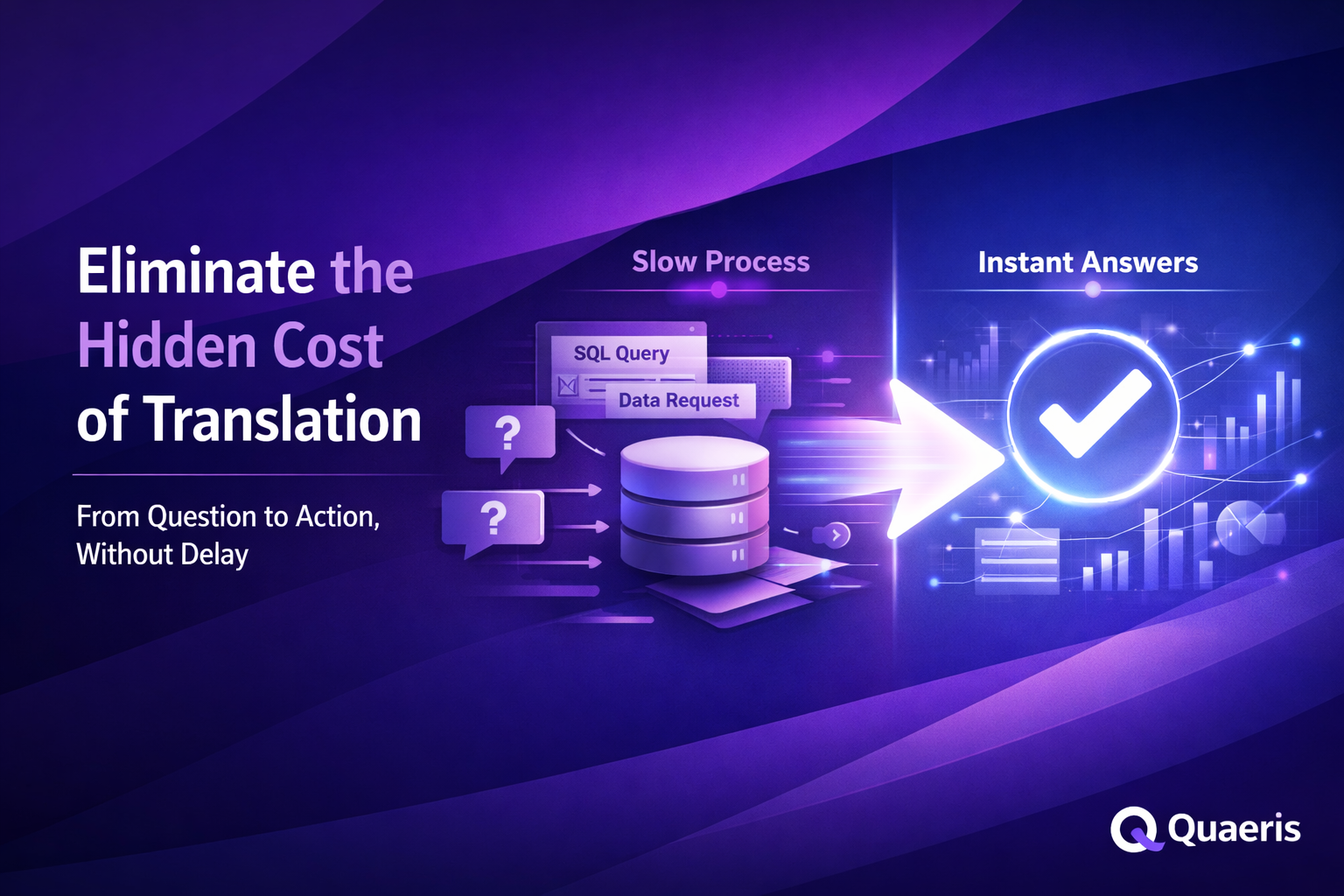
The Hidden Cost of Translating Business Questions into Queries
Every translation step from question to query introduces drag. Remove it with conversational data access.

Why teams don't trust the data — and what to do about it
Trust is the missing ingredient in most analytics stacks. Here's how to rebuild it across teams.
Ready to see it in action?
Book a 30-minute demo and get answers from your own data — live.
Clarity that moves work forward.