
Why the Same Business Question Gets Different Answers
Business users ask the same question in different ways and get different answers. Learn how interpretation gaps break trust, slow decisions, and how natural language creates consistent, trusted answers.
- NLQ is rapidly maturing and attracting heavy investment, moving beyond simple queries into visualization, anomaly detection, and recommendation systems.
- Healthcare, finance, and customer service teams are using NLQ to surface patterns in patient data, detect fraud, and automate customer responses at scale.
- NLQ is reshaping application design and the workplace by making software more accessible and giving non-technical users a natural way to query data.
- Education and policy making both benefit — from personalized learning feedback to analyzing socio-economic data for more informed decisions.
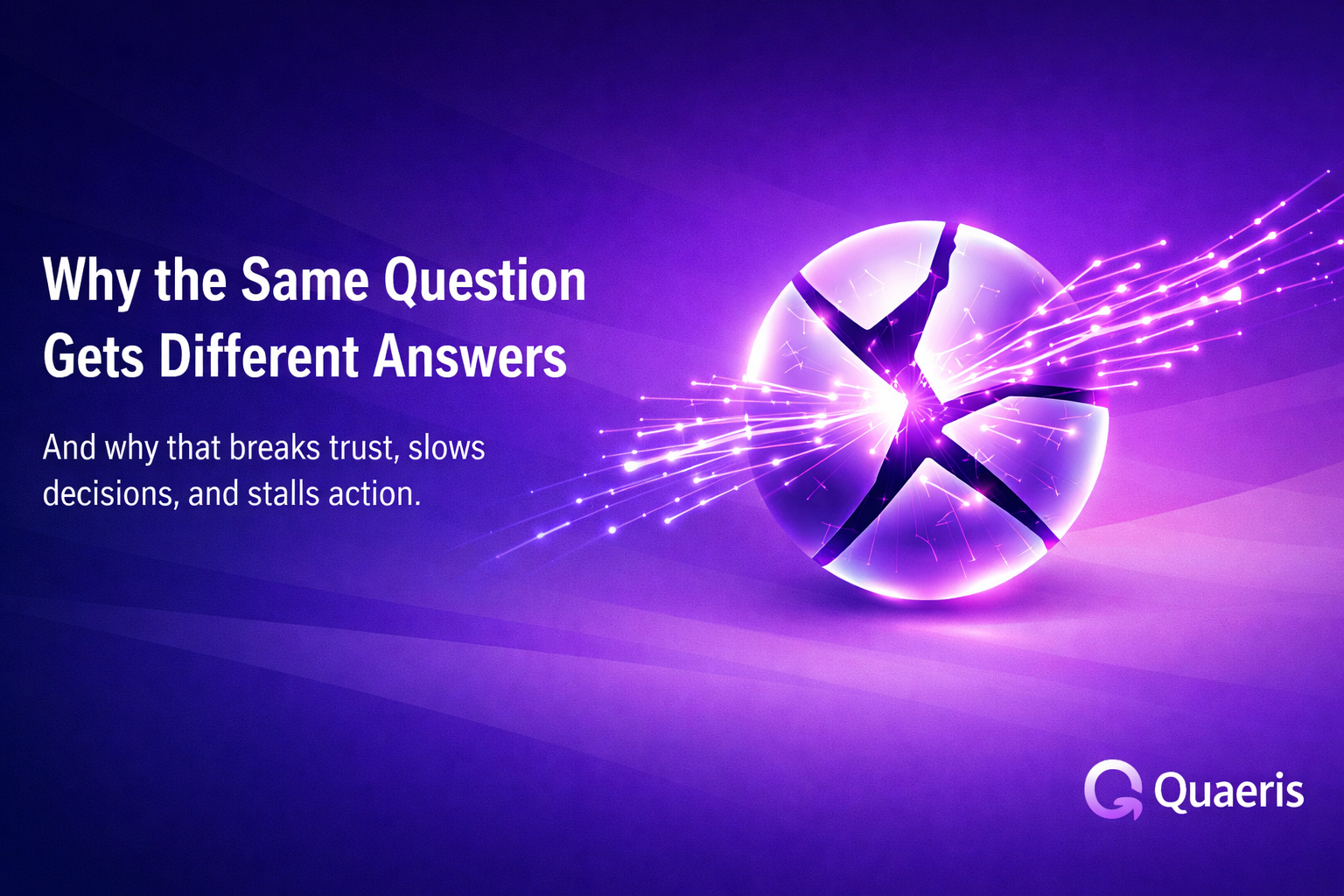
And why that breaks trust, slows decisions, and stalls action
Walk into any company and ask a simple question:
“What is our churn rate?”
Now watch what happens.
One leader checks a dashboard.
Another asks an analyst.
Someone else exports data into Excel.
A fourth person asks an AI tool.
You will not get one answer.
You will get many.
And that is the problem.
The hidden issue is not the question
It is interpretation
Business users do not think in queries.
They think in intent.
So they ask:
- “What is churn this quarter?”
- “How many customers did we lose?”
- “Are we retaining users?”
- “What is our retention trend?”
These sound the same.
They are not.
Each version carries different assumptions:
- Time range
- Definition of churn
- Data source
- Filters and exclusions
The system does not see intent.
It sees structure.
So it returns different answers.
This creates interpretation gaps across the business
When language varies, meaning breaks.
What starts as a simple question turns into:
- Multiple definitions
- Conflicting metrics
- Repeated analysis
This is not a data problem.
It is a translation problem.
Most tools require users to adapt to the system.
So every user creates their own version of the truth.
Over time, these gaps spread across teams.
Inconsistency becomes the norm
When the same question produces different answers, patterns emerge:
- Analysts rebuild the same logic again and again
- Dashboards show slightly different numbers
- Teams debate definitions instead of acting
This is why organizations feel slow even with strong data stacks.
The issue is not access.
It is inconsistency.
And inconsistency compounds.
Trust starts to break
Once answers conflict, people stop trusting the system.
They ask:
- “Which number is right?”
- “Where did this come from?”
- “Can I defend this in a meeting?”
At this point, behavior shifts.
People:
- Double check everything
- Build shadow analysis
- Go back to spreadsheets
- Rely on instinct
This is where decision confidence collapses.
And when confidence drops, action slows.
Decision delay is the real cost
The visible issue is confusion.
The real cost is time.
Every unclear answer creates:
- Follow up questions
- Analyst tickets
- Rework
- Meetings that restart the same debate
This is what we call decision drag.
Organizations do not stall because they lack data.
They stall because answers take too long and cannot be trusted.
Natural language changes the model
Natural language removes the burden of translation.
Instead of forcing users to:
- Learn query logic
- Navigate dashboards
- Interpret schemas
They simply ask:
“What is driving churn this quarter?”
The system does the work:
- Interprets intent
- Maps to governed definitions
- Applies the right context
- Returns a consistent answer
This is not about chat.
It is about alignment.
One question. One meaning. One answer.
When natural language is paired with context and governance:
- Different phrasings map to the same definition
- Metrics stay consistent across teams
- Answers are explainable and traceable
Now:
- Executives trust the output
- Analysts trust the logic
- Operators trust the action
This is where variability disappears.
And clarity begins.
Activation happens when friction disappears
When users no longer fight the system:
- More people ask questions
- Fewer tickets hit analysts
- Insight flows in real time
Access improves.
Noise drops.
Teams see what matters.
This is Activate.
Turning scattered information into usable answers for everyone.
Trust is what makes speed real
Speed without trust creates risk.
So teams slow down.
But when answers are:
- Grounded in governed data
- Consistent across questions
- Traceable to source
Something shifts.
People stop questioning the system.
They start acting on it.
This is Trust.
And trust is what turns answers into decisions.
The shift is simple. The impact is not.
From:
- Many ways to ask
- Many ways to interpret
- Many answers
To:
- Natural language input
- Unified context
- One trusted answer
This is how organizations move from:
analysis → confidence → action
Without delay.
Final thought
The problem was never that people asked questions differently.
The problem was that systems treated those questions differently.
Fix the interpretation.
You fix the outcome.
And when the outcome is clear,
the business moves.
Continue reading
View all posts →
How Decision Velocity Becomes a Competitive Advantage
Decision velocity is the new edge. See how rising flow signals translate into market wins.
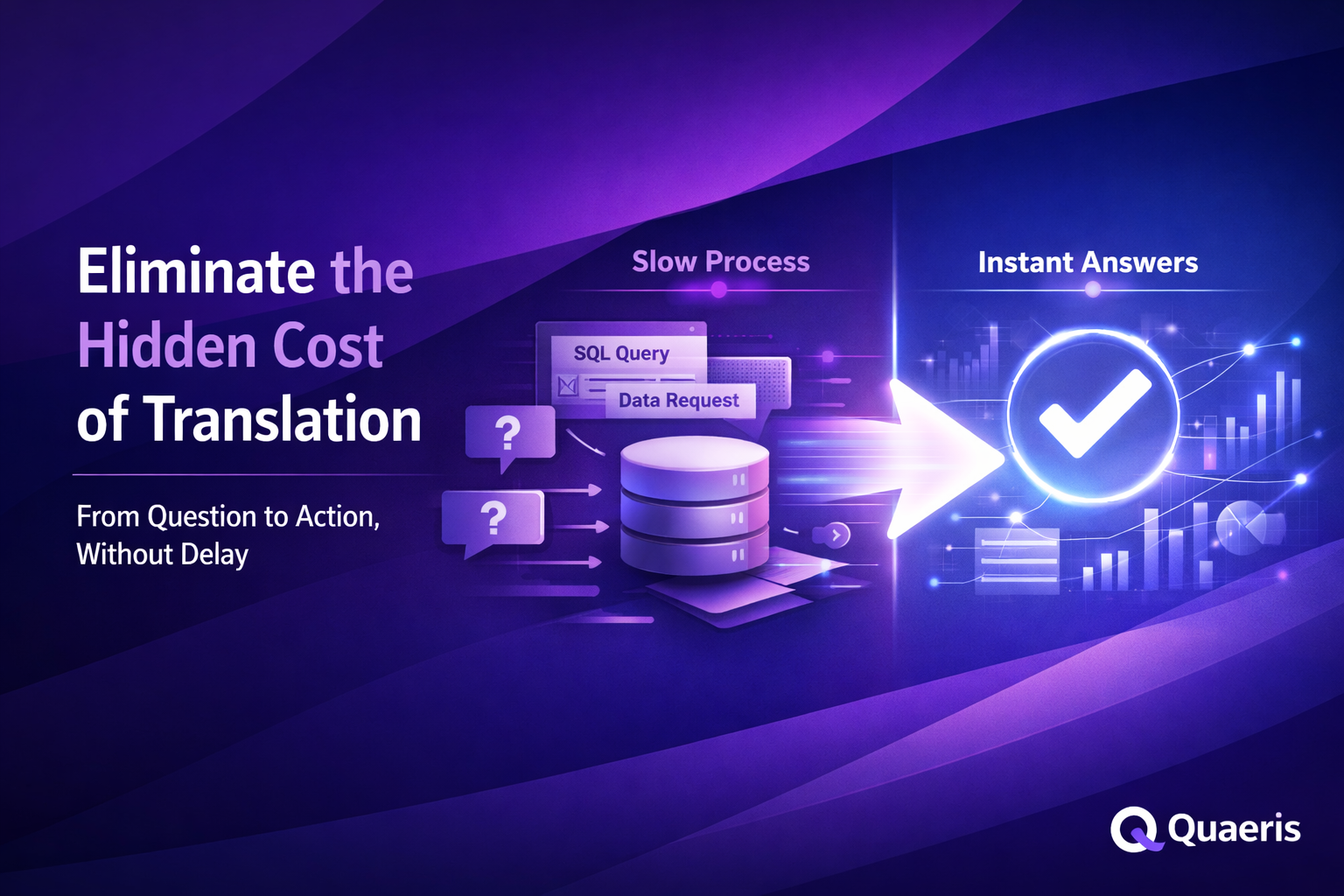
The Hidden Cost of Translating Business Questions into Queries
Every translation step from question to query introduces drag. Remove it with conversational data access.
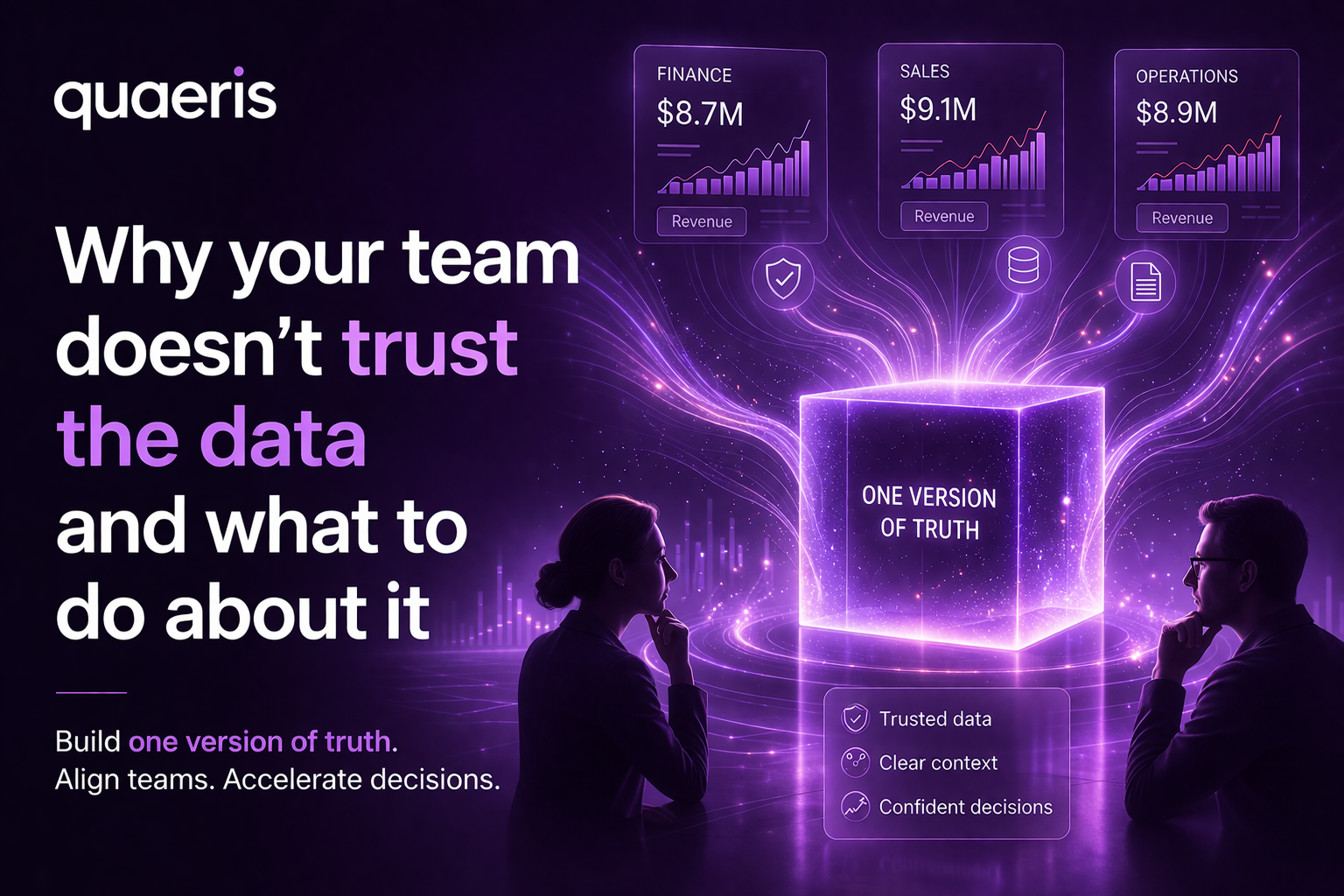
Why teams don't trust the data — and what to do about it
Trust is the missing ingredient in most analytics stacks. Here's how to rebuild it across teams.
Start using Quaeris today. Trusted answers in minutes.
See for yourself how fast and easy it is to uncover trusted insights hidden across your data and documents.
Try Quaeris For Free