

Why Analytics Must Live Where Decisions Happen
Analytics only drive action when they live inside the workflow. Learn why the location of insight determines decision speed and momentum.
- NLQ is rapidly maturing and attracting heavy investment, moving beyond simple queries into visualization, anomaly detection, and recommendation systems.
- Healthcare, finance, and customer service teams are using NLQ to surface patterns in patient data, detect fraud, and automate customer responses at scale.
- NLQ is reshaping application design and the workplace by making software more accessible and giving non-technical users a natural way to query data.
- Education and policy making both benefit — from personalized learning feedback to analyzing socio-economic data for more informed decisions.
Most organizations do not suffer from a lack of insight.
They suffer from distance.
Distance between where insight appears and where work actually happens.
A dashboard loads. A report refreshes. A chart updates. The data is correct. The math is sound.
Still, the decision waits.
This is not a tooling problem. It is a placement problem.
The location of insight determines the speed of action.
Insight Loses Power When It Is Elsewhere
Product, GTM, and operations leaders live in motion.
They are inside roadmaps, pipelines, tickets, forecasts, plans, and reviews. Decisions happen in the middle of work, not at the edge of it.
Yet analytics often lives somewhere else.
A separate tab.
A separate meeting.
A separate moment in the week.
Insight becomes something you go check, not something that moves with you.
That separation matters more than most teams admit.
When insight is detached from workflow, three things happen fast.
First, context decays.
Second, urgency fades.
Third, ownership blurs.
By the time the data is reviewed, the moment has often passed.
Distribution Is the Real Bottleneck
Analytics teams spend years improving accuracy, freshness, and coverage. These are important. They are not enough.
What slows decisions is not insight quality alone. It is insight distribution.
Where does the answer show up.
Does it appear inside the tool where the decision is being made.
Or does it require a context switch.
Every switch adds friction.
Leaders know this feeling well.
You are in a planning meeting. A question comes up.
Someone says the data exists.
Someone else says it lives in a report.
The room pauses.
Now the choice is simple but costly.
Do we wait.
Or do we decide without it.
Most teams choose the second. Not because they want to, but because the work cannot stop.
This is how insight gets ignored without anyone intending to ignore it.
Workflow Is Where Confidence Forms
Confidence is not built by seeing a chart once a week.
It is built by repeated exposure in real moments.
When insight appears inside workflow, it does not feel like analysis. It feels like part of the work.
This changes behavior.
Questions get asked sooner.
Follow ups happen naturally.
Decisions feel supported, not delayed.
The same insight delivered in a different place produces a different outcome.
This is why distribution matters more than presentation.
It is not about prettier charts.
It is about fewer handoffs.
The Cost of Separation Shows Up Everywhere
Product leaders feel it when roadmap decisions rely on gut feel despite strong usage data.
GTM leaders feel it when pipeline calls recycle the same debates week after week.
Operations leaders feel it when teams escalate decisions that should be routine.
In each case, the pattern is the same.
Insight exists.
It is trusted in theory.
It is absent in the moment.
So decisions default to instinct, hierarchy, or habit.
This is not a failure of people. It is a failure of placement.
Why Centralization Quietly Slows Teams
Many analytics programs were built around central access.
One place to go. One system of record. One source of truth.
This made sense when data was scarce and compute was expensive.
But centralization has an unintended side effect.
It trains teams to leave their work to get answers.
That exit is small. The cost is not.
Every time someone leaves workflow to seek insight, they lose momentum.
They may not come back with the answer.
They may not come back at all.
The decision moves on.
Analytics Should Follow the Decision Path
Modern work is not linear.
Decisions unfold across tools, people, and time.
Analytics must follow that path, not sit at the end of it.
This does not mean copying dashboards everywhere. It means making answers available where questions naturally arise.
Inside planning.
Inside review.
Inside execution.
When analytics moves closer to action, speed increases without pressure.
Not because people are forced to decide faster.
Because friction is removed.
What Changes When Insight Is In Place
When insight lives where decisions happen, subtle shifts appear.
Meetings get shorter.
Questions get sharper.
Debate moves from numbers to options.
Teams stop re explaining the past and start choosing the future.
Analytics teams feel this too.
Less reactive work.
Fewer repeat asks.
More time spent shaping meaning instead of producing artifacts.
The system starts to work with the organization, not beside it.
This Is Not About Tools
It is important to be clear.
This is not a call to replace systems.
It is not a comparison of platforms.
It is not a feature discussion.
This is a behavior discussion.
Where do people pause.
Where do they ask.
Where do they decide.
Analytics that ignores these questions will always feel slow, no matter how advanced it becomes.
Speed Comes From Proximity
Speed is not urgency. It is readiness.
When insight is close, teams are ready to act.
When it is far away, they hesitate.
The location of insight determines the rhythm of the business.
Distributed insight creates flow.
Detached insight creates delay.
This is the quiet truth many organizations are now confronting.
A Simple Reflection
Ask one honest question.
When a critical decision happens tomorrow, where will the insight be.
In the room.
Or somewhere else.
The answer to that question says more about decision speed than any roadmap ever will.
Analytics must live where decisions happen.
That is how insight becomes action.
Continue reading
View all posts →
How Decision Velocity Becomes a Competitive Advantage
Decision velocity is the new edge. See how rising flow signals translate into market wins.
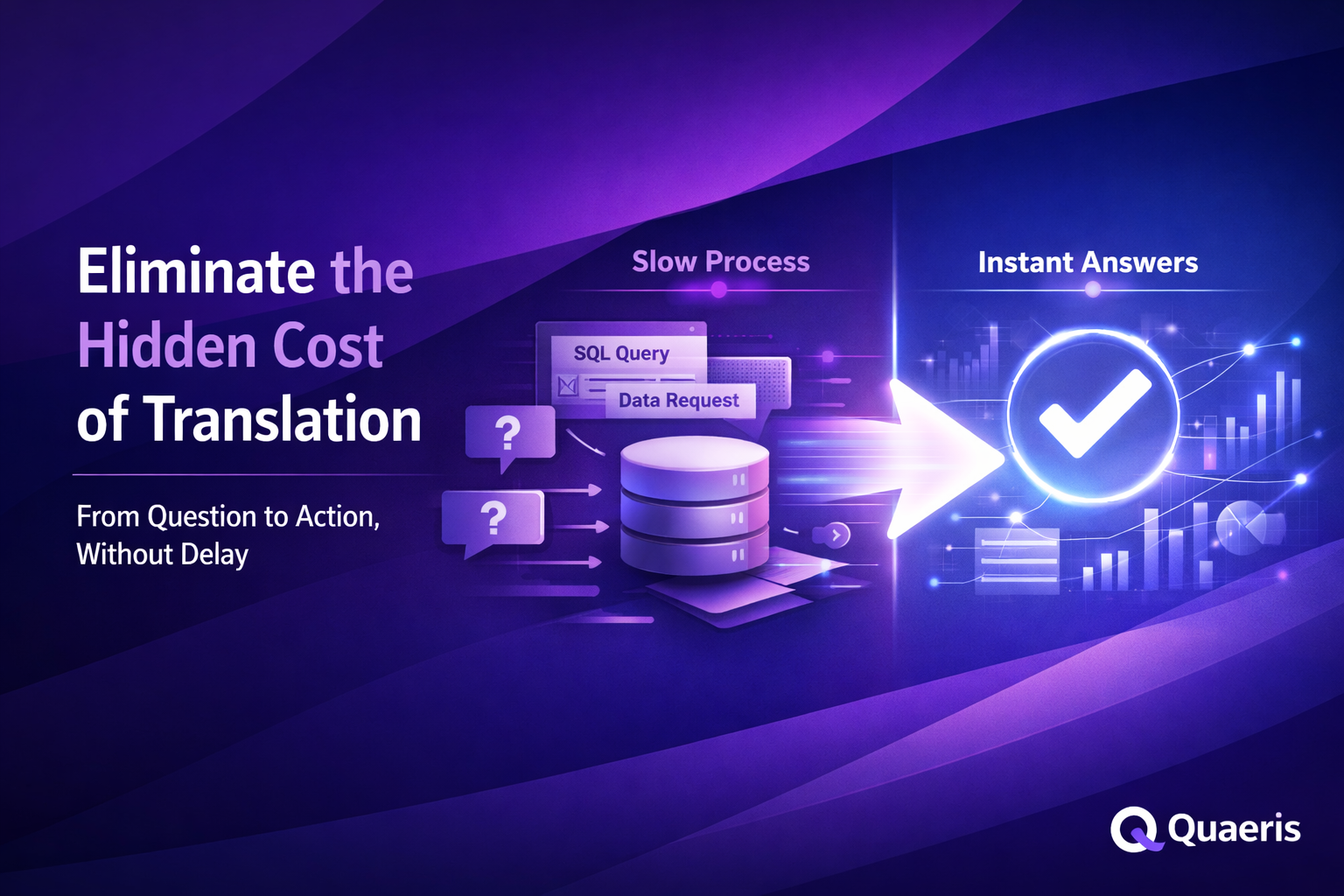
The Hidden Cost of Translating Business Questions into Queries
Every translation step from question to query introduces drag. Remove it with conversational data access.
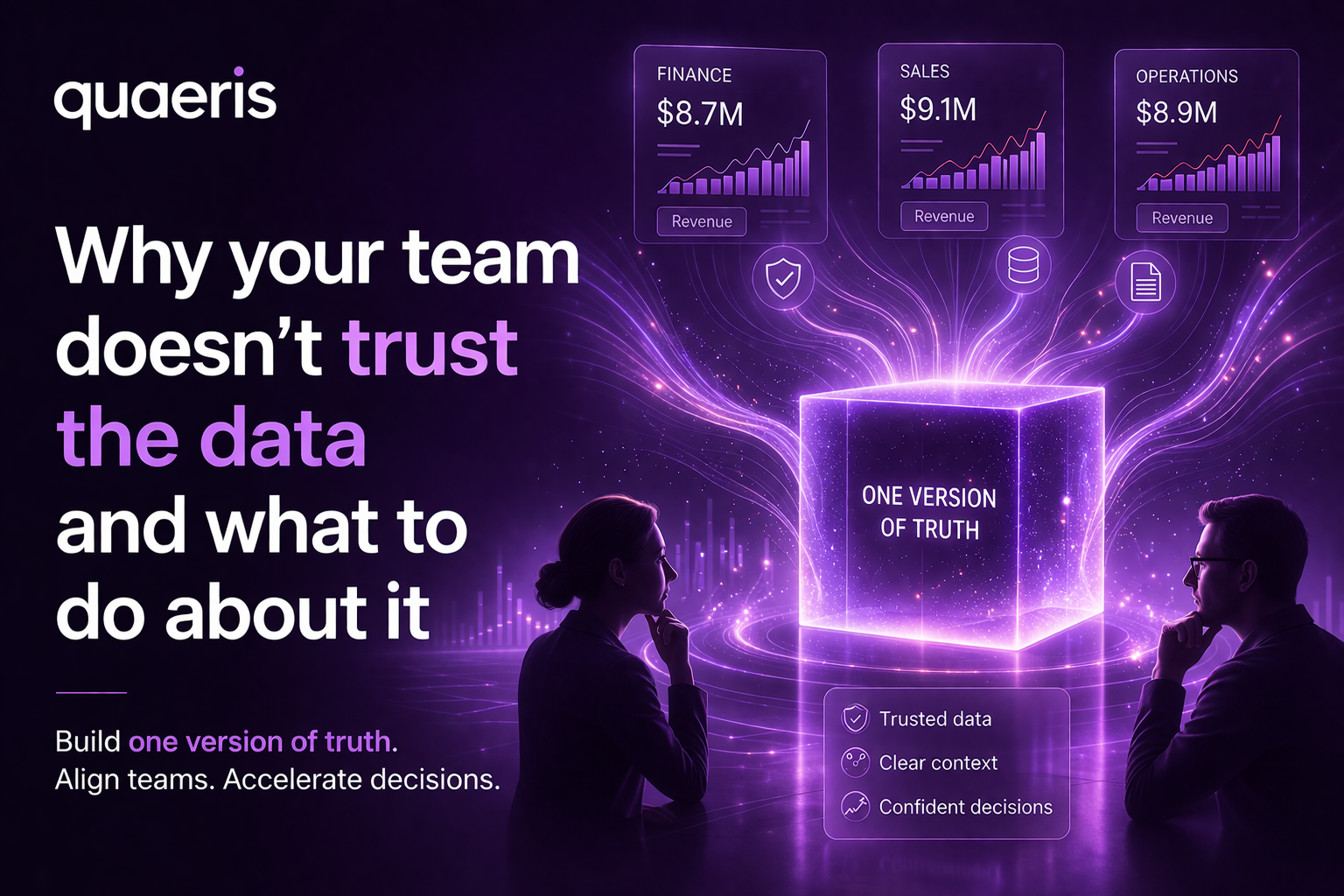
Why teams don't trust the data — and what to do about it
Trust is the missing ingredient in most analytics stacks. Here's how to rebuild it across teams.
Start using Quaeris today. Trusted answers in minutes.
See for yourself how fast and easy it is to uncover trusted insights hidden across your data and documents.
Try Quaeris For Free